
Smart Lock Card Technology in Pakistan: Detail Guide
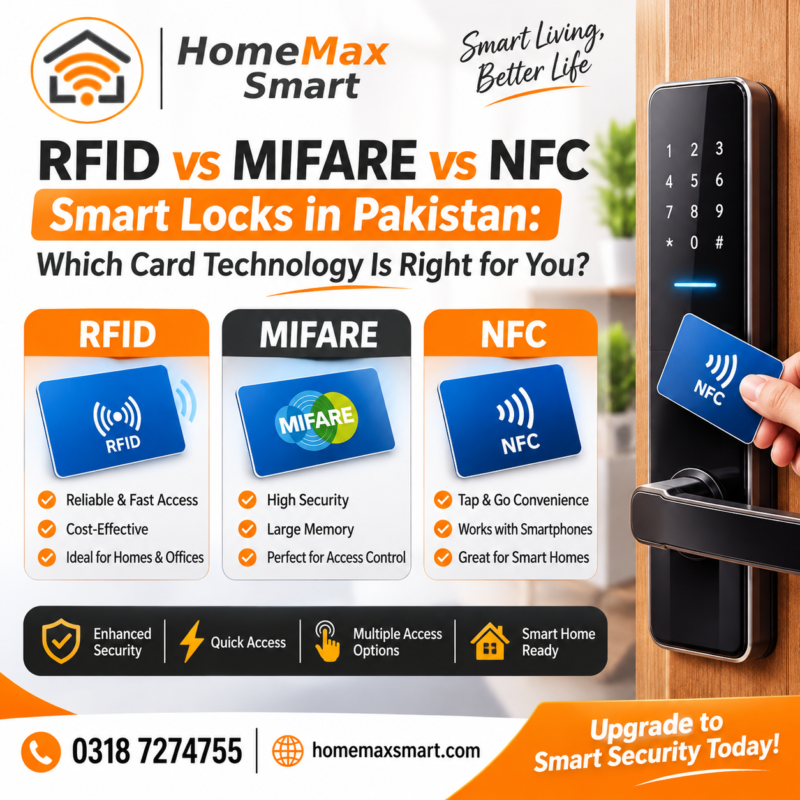
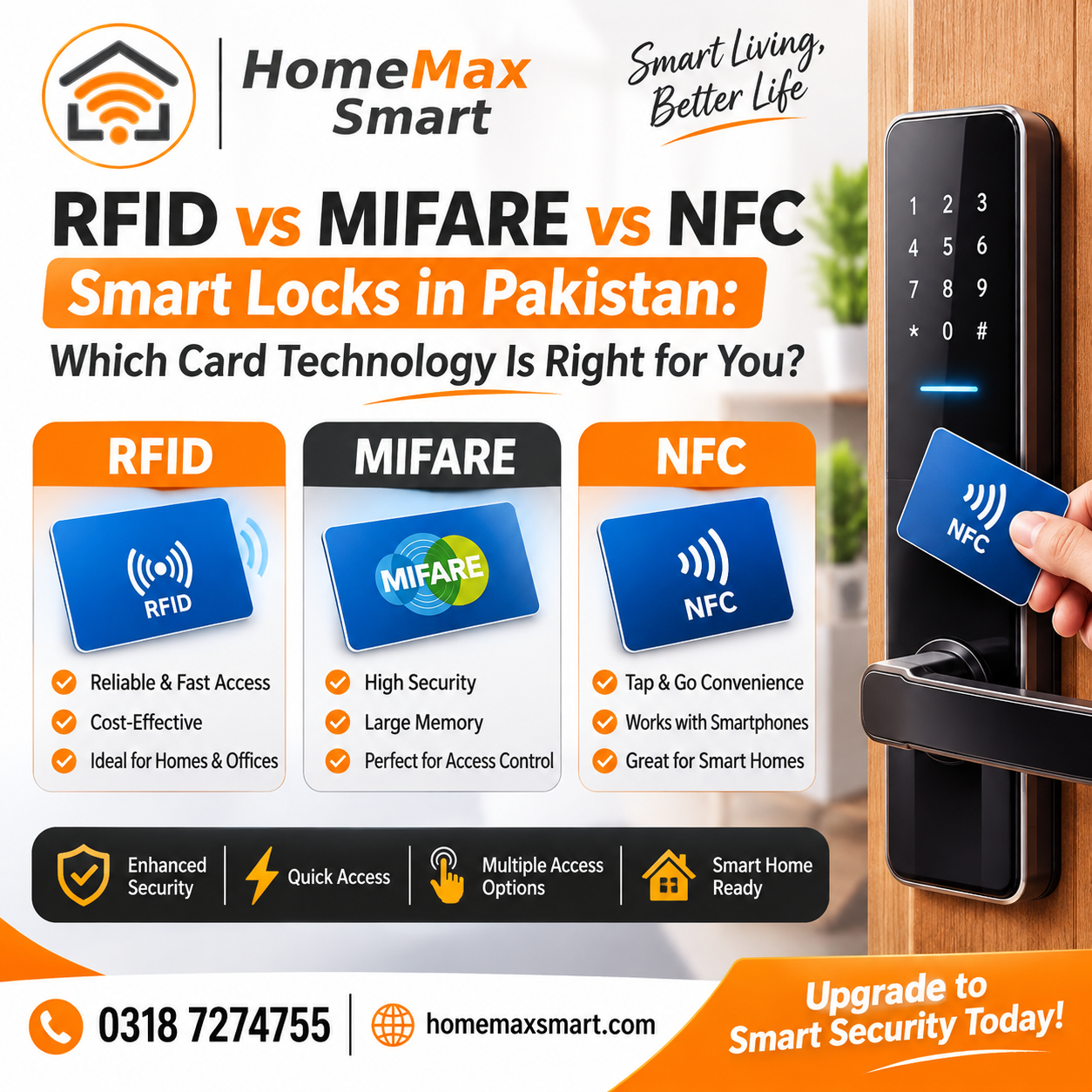
If you are shopping for a smart card lock in Pakistan, you will hear three terms again and again: RFID, MIFARE and NFC. Shopkeepers often use them as if they mean the same thing. They don’t, and the difference decides how safe your door really is.
This guide explains each one in simple words, shows where each works best, and covers local worries like load shedding, heat and unstable internet. It is written for homeowners, landlords, guest house owners and office managers.
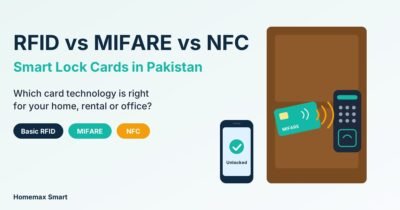
Choosing the right card technology for your door
Quick answers (read this if you are in a hurry)
- Basic RFID: cheapest, but easy to copy. Fine for a store room, not for a house or rental.
- MIFARE: the best all-round choice for homes, rentals and offices. Pick MIFARE Plus or DESFire for higher security.
- NFC: lets your phone work as the key. Great if your family uses Android phones, but always keep a backup way in.
- Load shedding: good smart locks run on batteries, so a power cut doesn’t stop them.
How a Smart Door Lock Reads Your Card
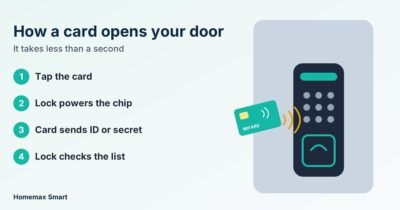
Every card-access door lock has a reader inside it and a card with a tiny chip. The card has no battery. When you bring it close, the lock’s radio signal powers the chip for a split second, the card sends back its ID or a secret answer, and the lock decides whether to open.
The key point is what the card sends. A simple card just shouts its ID. A smart card proves who it is with a secret key. That one difference is why some cards are copied easily and others are not.
What Is an RFID Door Lock?
RFID means Radio Frequency Identification. It is the big family name for any chip that talks by radio. Door cards, bus passes and even pet microchips all use it.
For door locks you will meet two main types:
| Type | Frequency | Range | Where you see it |
|---|---|---|---|
| Low frequency | 125 kHz | Up to about 10 cm | Basic cards and key fobs on budget locks |
| High frequency | 13.56 MHz | A few cm to 10 cm | MIFARE cards, NFC, hotel and office locks |
Basic 125 kHz RFID cards: cheap but easy to clone
These cards hold one fixed ID number and send it with no protection. A cheap cloner can copy one in seconds. Use them for low-risk doors only.
What Is a MIFARE Card Lock?
MIFARE is a brand of smart card made by NXP and used in hotels, offices and city transport around the world. It runs at 13.56 MHz and has memory and encryption inside. The version you choose matters.
MIFARE Classic: affordable but older
Classic cards come with 1 KB or 4 KB of memory. Their old Crypto1 encryption was broken years ago, so they are fine for a normal home or small rental but not for high-security doors.
MIFARE Plus: a safer upgrade
MIFARE Plus can use AES-128 encryption, which is far stronger. It is a good step up if you want better security without a big jump in cost.
MIFARE DESFire: best for offices, hotels and apartments
DESFire (EV1, EV2, EV3) uses AES-128 and can keep a separate secret key for each door or area. This is the one to ask for if you manage many users.
The UID trap
Every card has a unique ID number called a UID. Some cheap locks check only that number, which makes even a good card easy to fake. Ask the seller whether the lock checks the card’s secret key and not only the UID.
What Is an NFC Smart Lock?
NFC works on the same 13.56 MHz technology, but you must tap from about 4 cm or less. Its big advantage is that a phone can act as your key, so there is no card to lose.
NFC phone key: what to know in Pakistan
Most people here use Android phones, and many Android phones have NFC, so phone keys are often an easy option. iPhones are more limited, and support depends on the model, the iOS version and the lock. Check the lock’s phone compatibility list before you pay. And remember: if the phone battery dies, the phone key stops working, so choose a lock with a backup like a PIN, card or mechanical key.
RFID vs MIFARE vs NFC: Comparison Table
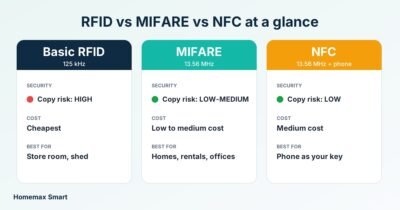
| Basic RFID | MIFARE | NFC phone key | |
|---|---|---|---|
| Copy risk | High | Medium (Classic) to very low (DESFire) | Low when set up properly |
| Cost | Lowest | Low to medium | Medium |
| Needs a phone | No | No | Yes |
| Best for | Store room, shed | Homes, rentals, offices | Tech-friendly families, guest houses |
Real Smart Lock Problems in Pakistan and Their Solutions
Landlords with several rented portions
A landlord in Lahore with five portions had to change locks every time a tenant left. With MIFARE cards he deletes the old card and issues a new one in minutes. No locksmith, no waiting, and the old card is dead at once.
Joint families and domestic staff
A large family home in Karachi shared one set of keys among twelve family members, a maid, a driver and a cook. Nobody knew who had what. With one card per person, staff access can be limited and removed the day someone leaves, and an entry log shows who opened the door and when.
Guest houses and Airbnb hosts
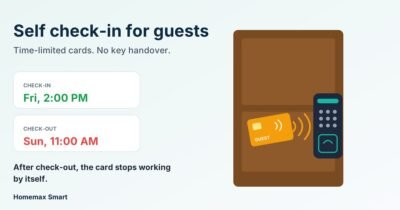
An Islamabad host was tired of waiting up for late flights. Time-limited cards or codes solved it: set the check-in and check-out dates, and access ends on its own. No lockbox, no lost spare keys.
Small offices with cloned cards
An office in Rawalpindi used cheap basic cards. A visitor cloned one with a small device and later a stranger reached the store room. Moving to MIFARE Plus or DESFire, with a lock that checks the secret key, makes this much harder to repeat.
Hostels with lost cards
Students lose cards often. A hostel owner doesn’t want to re-key doors every semester. A lock that holds many cards and lets you remove single ones turns a lost card into a two-minute fix.
What to Check Before Buying a Smart Lock in Pakistan
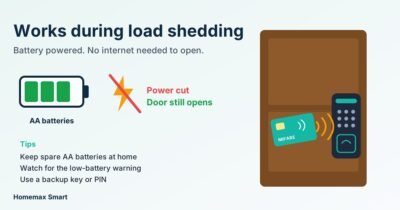
Does it work during load shedding?
Yes, if it is battery powered. Check for a low-battery warning and an emergency power port or backup key, and keep spare batteries at home.
Does it work without internet?
It should. Cards, PIN codes and fingerprints must work offline. Internet is only for remote features like adding a guest from another city.
Can it handle heat, dust and humidity?
Summers in cities like Multan are hard on electronics, and Karachi brings humidity and salty air. Ask about the weather rating and body material, especially for a gate-facing door.
What after-sales support is offered?
Ask who installs it, who handles warranty, and whether batteries and spare parts are easy to get locally.
How many users and cards can it store?
Pick a lock with extra room to grow, especially for rentals, hostels and offices.
How to Choose the Best Smart Lock for Your Home or Business
- Who uses the door? One family, many tenants, staff or guests?
- How risky is a copied card? A garage and a locker room are different.
- How often do users change? Rentals and hostels need easy card removal and time limits.
- Do you want a phone key? If yes, check your phone model first.
A rough guide: family home, MIFARE cards plus a PIN. Rentals and apartments, MIFARE Plus or DESFire. Offices, DESFire with an entry log. Guest houses, time-limited access with NFC or PIN as a bonus.
Smart Lock Card FAQs for Pakistani Buyers
What is the difference between RFID, MIFARE and NFC?
RFID is the big family of radio ID technology. MIFARE is a brand of 13.56 MHz smart cards inside that family. NFC is a short-range standard in the same family that lets a phone act as a card.
Will my smart lock stop working during load shedding?
No, not if it is battery powered. Change the batteries when the low-battery warning appears, and keep spares.
Which is better for a house: MIFARE or RFID?
MIFARE. Basic RFID is easy to copy, while MIFARE offers real encryption, especially in the Plus and DESFire versions.
Is MIFARE Classic safe enough?
For a normal home or small rental, it is a reasonable budget choice. For offices, apartment buildings or valuable storage, choose MIFARE Plus or DESFire.
Can I use my old 125 kHz card on a MIFARE lock?
Usually not. The two use different radio frequencies, so the lock cannot read the card.
Does an NFC phone key work on every phone?
No. It depends on the phone model, the operating system and the lock’s app. Many Android phones work, while iPhones are more limited. Check before you buy.
What happens if my phone battery dies?
The phone key stops working. That is why a good lock also supports cards, a PIN or a mechanical key.
Can I give a guest access for a few days only?
Yes, if the lock supports time-limited cards or codes. Set the dates and access ends automatically.
What if I lose my card?
Remove it from the lock using the app or the lock menu. It stops working immediately.
Do the cards need batteries?
No. The lock’s radio signal powers the card for the tap. Only the lock needs batteries.
Can I copy a card at a market shop?
Only use your lock’s own card-adding feature. Roadside cloning is the exact risk you are trying to avoid, and some blank cards are not compatible anyway.
How long do smart lock batteries last?
Usually 3 to 6 months, depending on use. Busy doors like hostels and offices drain them faster.
Can one card open more than one door?
Yes, if each lock is set to accept it. DESFire can keep a separate secret for each door, which is safer.
Choose the Card Technology That Fits Your Door
Basic RFID is cheap but easy to copy. MIFARE is the sensible choice for most homes and rentals, and DESFire suits offices and apartment buildings. NFC adds the comfort of a phone key. Whatever you pick, choose a lock with more than one way in, that works without internet, and comes from a brand that answers when you need help.
At Homemax Smart, we help you choose the right smart door lock for your home, budget and building. Message our team with details of your property, and we’ll recommend the right fit.